

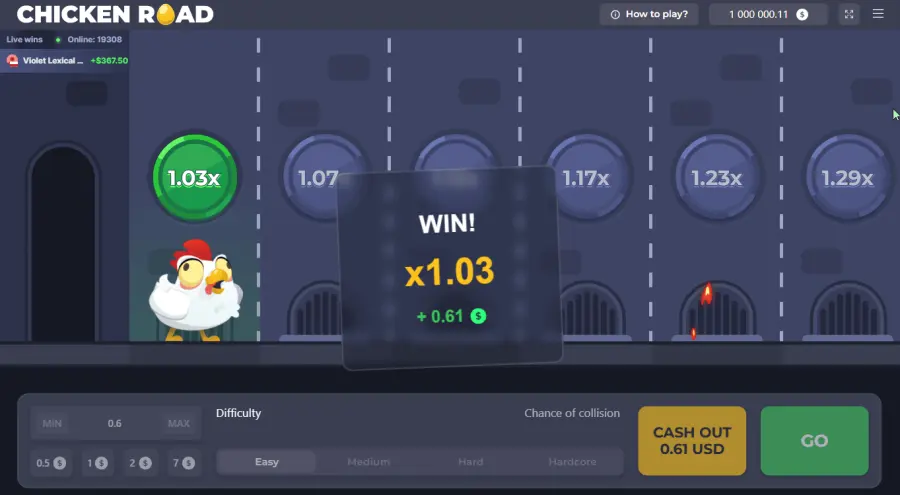




Chicken road game review for Canada real money casino players

Here is a clear look at Chicken Road for Canadian real money players. The title plays like a grid-based risk ladder where you pick safe tiles, dodge traps, and climb multipliers. This chicken road game review focuses on gameplay flow, volatility feel, and what to check before staking. Availability differs by province, with Ontario sites regulated by AGCO and iGO, and other regions using provincial lottery platforms. Players searching for chicken road canada usually want smooth mobile performance, quick rounds, and responsible tools. You may find chicken road casino listings filed under Arcade or Instant Win. Expect transparent rules, disclosed odds, and adjustable limits wherever you play.
Where to play chicken road casino in canada online
Here’s where Canadians are actually loading up this quirky arcade title. Ontario’s regulated lobbies now carry broader instant‑win catalogs, while the rest of Canada typically plays on nationally available brands that fully support CAD. Availability can sit under Arcade, Instant Games, or Crash, so the search bar helps. Many players ask where to find a reliable chicken road casino. Pick a site that publishes RTP, shows responsible gaming tools, and lists payment processing times up front. Licensed operators verify ID before withdrawals, which protects your balance and limits. Below are trusted casinos known for quick Interac payments, clean mobile apps, and consistent uptime so the game runs smoothly during peak evening traffic.
- 888casino Ontario — AGCO/iGaming Ontario site with an Arcade category, Interac support, and the game available for real money after login.
- Betway Casino Ontario — Regulated lobby where the title appears under Instant Games; smooth CAD banking and reliable mobile play.
- LeoVegas Casino Ontario — Strong search, quick load times, and Interac deposits; demo typically available once you’re logged in.
- Sports Interaction (Ontario) — Clear cashier limits, fast Interac payouts, and the arcade section lists the game for CAD play.
All recommendations below hold active provincial authorization in Ontario and display iGaming Ontario and AGCO details in footers. That oversight means game catalogs are certified, payments are segregated, and dispute channels exist if something goes wrong. These picks suit chicken road canada play thanks to clear limits, published withdrawal queues, and transparent bonus terms that do not block instant‑game wagering. Player feedback highlights fast identity checks, predictable cash‑out windows, and helpful live chat when sessions drop. If you prefer a test run, most lobbies allow practice after login, then a switch to real CAD once funded. Interac e‑Transfer support keeps deposits familiar for Canadian banking and speeds up verified withdrawals.
| Casino name | License and regulator | Available modes for Chicken Road (demo / real CAD) | Top-3 CAD deposit methods | Top-3 CAD withdrawal methods |
|---|---|---|---|---|
| 888casino Ontario | AGCO (Alcohol and Gaming Commission of Ontario) + iGaming Ontario | Demo (login required); Real CAD | Interac e‑Transfer; Visa; PayPal | Interac e‑Transfer; PayPal; Bank Transfer |
| Betway Casino Ontario | AGCO + iGaming Ontario | Demo (login required); Real CAD | Interac e‑Transfer; Visa; PayPal | Interac e‑Transfer; PayPal; Bank Transfer |
| LeoVegas Casino Ontario | AGCO + iGaming Ontario | Demo (login required); Real CAD | Interac e‑Transfer; Visa; Mastercard | Interac e‑Transfer; Bank Transfer; Instadebit |
| Sports Interaction (Ontario) | AGCO + iGaming Ontario | Real CAD | Interac e‑Transfer; iDebit; Visa | Interac e‑Transfer; iDebit; Bank Transfer |
Top canadian casinos with chicken road game gambling access
A handful of Canadian brands stand out for discoverability, uptime, and payments when you want quick access to this arcade game. Their lobbies surface the title via search and place it in Arcade or Instant categories, which trims scrolling on mobile. Ontario apps such as 888, Betway, LeoVegas, and Sports Interaction sync sessions across devices, so a round started on desktop can continue on your phone. Payment sections are upfront about minimums and processing times, which lowers surprises during cash out. Look for clear RTP disclosure on the game info panel and a visible clock icon tracking session time to help manage bankroll.
How to find chicken road official sites for canada
Finding the authentic landing page is easier when you follow a short checklist. Visit the casino homepage and confirm the AGCO and iGaming Ontario seals in the footer before searching the game name in the lobby. Always open the game info panel to verify RTP and provider details, then run a few demo rounds after login to check stability. You can also compare the cashier’s posted fees and limits before depositing. Use only the site’s app store links or QR codes listed in the lobby. That approach keeps you on a chicken road official path rather than a copycat domain.
Using cad to play chicken road casino safely
Playing in CAD keeps math simple and reduces foreign exchange fees that nibble at small wins. Interac e‑Transfer, Visa or Mastercard, and PayPal or iDebit usually cover the first deposit, while withdrawals lean on Interac and direct bank transfer. Set a session limit and loss cap before opening the game, then confirm your ID documents are uploaded to avoid cash‑out delays. Ontario sites post typical timelines, with Interac often clearing in hours after approval. Always recheck bonus terms because some offers exclude arcade or crash titles from wagering. A clean, funded wallet and verified profile make each round smoother and safer.
How to register and start chicken road in one minute
As of 2026, signing up on a provincially licensed Canadian casino is straightforward and fast, especially on operators aligned with iGaming Ontario and FINTRAC guidance. You create a secure account, verify contact details, and confirm legal age, which is 19+ in most provinces. KYC usually finishes in the background, so the lobby opens right away. Payment limits, self‑exclusion tools, and geolocation checks are built into the flow. Search the lobby, favorite the title, and adjust session reminders before you start. Many sites also offer a quick demo to get familiar with the mechanics. Launch and try a few low‑stake runs to test volatility. When ready, open the cashier and proceed to play chicken road responsibly.
- Pick a provincially licensed casino (e.g., overseen by iGaming Ontario, Loto‑Québec, BCLC, or ALC).
- Tap Join and enter email, mobile number, and a strong password, then confirm you are 19+ where required.
- Verify your email or SMS code to activate the account and enable geolocation.
- Complete KYC with legal name, DOB, address, and a government photo ID or instant database match.
- Open the cashier, set limits, and make your first deposit in CAD via Interac or cards.
- Search the lobby, launch the game, and opt into a welcome offer only if the terms suit you.
On modern Canadian platforms, the whole journey from registration to the first round typically takes about a minute when instant checks pass. If manual review is triggered, deposits and gameplay unlock after approval, which commonly lands within minutes or a few hours.
Step by step account setup for chicken road canada players
Start by selecting your province, then tap Join to enter email, mobile number, and a strong password. Confirm you are of legal age and accept the T&Cs after reading the key limits and privacy points. Verify your email or SMS code to activate the profile. Add your real name and address exactly as on your ID to avoid delays later. Set two‑factor authentication and a unique security question for recovery. Enable geolocation when prompted for compliance in Ontario and other regulated markets. Open the lobby search and bookmark the title you plan to try. This streamlined setup works smoothly for chicken road canada players.
Verifying identity and kyc for chicken road casino access
Canadian casinos verify identity to meet FINTRAC anti‑money‑laundering rules and provincial licensing standards, such as those overseen by iGaming Ontario. Expect to provide a government photo ID, your date of birth, and a recent document showing your address. Many sites use instant database checks, while others request a live selfie to confirm liveness. If the automated match fails, a manual review kicks in. Keep scans clear, corners visible, and names consistent to avoid bounce‑backs. During KYC, geolocation runs in the background to confirm you are within the permitted province. Once approved, deposit options and the full game catalog unlock without restrictions.
Depositing cad and claiming bonuses for chicken road game gambling
Head to the cashier and choose a method like Interac e‑Transfer, Visa, or Mastercard, then set a realistic deposit limit. Most Canadian sites process card and Interac payments instantly, with minimums commonly around 10–20 CAD. Review welcome offers carefully before opting in. Wagering, time limits, and game weighting can affect bonus value in practice. Some instant‑win titles contribute less or may be excluded, so check the contribution table. Activate the offer on the deposit screen to avoid missing it. Withdrawals require completed KYC and may take longer. Play chicken road game gambling only after you understand the promotional terms. Set reality checks to keep sessions balanced.
Chicken road slot overview payout limits rtp and volatility

Chicken Road blends crash-style tension with simple tap-to-cashout play, so limits matter. The base RTP varies by version and operator integration, typically hovering near 96% with some builds nudging slightly higher. Volatility is firmly high because round outcomes cluster and long safe streaks can end abruptly. Betting ranges are friendly, starting from small coins and scaling to table caps chosen by the casino. Payout ceilings are defined by a max multiplier and separate cash cap, which can restrict the theoretical peak. The session rhythm favors short, controlled bursts rather than marathon play. The chicken road slot label reflects how many lobbies categorize it, although it behaves like a multiplier crash game.
Key facts about chicken road gambling game mechanics and rules
Each round starts at 1.00x and the multiplier climbs until a crash event ends the run. You place a stake before the countdown, then cash out at any point to bank the current multiplier. Auto-cashout lets you preselect a target, reducing reaction risk in fast rounds. Two-bet mode allows running conservative and aggressive strategies simultaneously. Rounds resolve in seconds, so bankroll management benefits from small unit sizing. Session logs show previous multipliers, but they do not influence future outcomes. The chicken road gambling game uses a simple rule set that rewards discipline over guesswork. Cashouts processed after the crash do not pay.
Rtp volatility and max win of chicken road game casino
Most builds list an RTP around 96.0%, with some markets offering slightly different settings due to platform rules. High volatility means long stretches of modest results can be punctuated by rare, large multipliers. Hit rate is round-dependent because the crash can occur immediately or far into a run. Many operators cap the maximum multiplier near 5,000x alongside a separate cash payout ceiling. Check the game panel for your site’s exact configuration before playing. The chicken road game casino presentation sometimes summarizes this as risk: high, RTP: mid‑96s, max win: capped by multiplier and cash limit. Strategy cannot overcome variance.
Demo mode and free chicken road game review for beginners
Free-to-play sessions mirror the live math, letting you practice timing and auto‑cashout settings without risk. Canadian players outside Ontario usually see demo access in the lobby, while Ontario sites may gate it behind age and location checks. Use the sandbox to test two-bet splits, laddered targets, and stop-loss rules. Track at least 50 rounds to feel the rhythm and note how quickly runs can end. Treat demo streaks cautiously because short samples can mislead. Once comfortable, translate settings to real stakes conservatively. Keep session length short, lock profits often, and avoid chasing after a sudden bust. Small units preserve flexibility.
| Parameter | Value | Notes for Canadian players |
|---|---|---|
| Provider | InOut Games | Appears in crash/multiplier sections on many lobbies. |
| Release year | 2023 | Availability may vary by province and site. |
| Game type | Crash-style multiplier | Cash out before the crash to secure winnings. |
| RTP range (versions) | ~96.0% default; some builds ~96.5%–97.0% | Exact RTP set by operator integration. |
| Volatility | High | Expect rare big runs and frequent low exits. |
| Min/Max bet | C$0.10 – C$50 | Limits can differ by casino brand. |
| Maximum win cap | Up to C$250,000 or 5,000x | Whichever comes first; subject to site cap. |
| Demo mode availability | Yes (site-dependent) | Ontario may require verified access due to AGCO rules. |
| Provably fair/certification | Server RNG; certification varies | Look for lab/regulated badges on your casino’s footer. |
Playing chicken road gambling game on desktop and mobile
Playing on desktop or mobile is straightforward, because Chicken Road runs in standards‑based HTML5 directly in your browser. No APK, installer, or dedicated app is required for Canada. The chicken road gambling game typically loads within seconds on recent Chrome, Safari, Firefox, and Edge builds. Desktops deliver steadier frame rates, larger hitboxes, and the most consistent audio, which suits longer sessions. Phones trade some raw power for instant access, haptics, and quicker taps. First loads usually fetch 8–15 MB of assets, with cached replays dropping subsequent data use to modest trickles. As of 2026, 5G across major Canadian carriers keeps latency low, while Wi‑Fi remains the best option for stability.
Chicken road casino gameplay in browser on canadian smartphones
Open Chrome or Safari and the game boots quickly in a clean canvas with responsive touch targets. iOS and Android handle inputs natively, so swipes, taps, and multi‑touch gestures feel predictable. The chicken road canada community reports smoother 60 fps on newer devices, with older models hovering near 30–45 fps. Expect an initial download for textures and audio, then light incremental requests as rounds progress. Over LTE or 5G, hourly usage generally stays moderate thanks to caching, though animated assets can raise the total. For long play, keeping battery saver off avoids throttling that can cause input delay or stutter.
Chicken road app alternatives and mobile web experience in canada
There is no official native app, and you do not need an APK, because the browser version is the current reference build. If you want an app‑like feel, use Add To Home Screen to launch a full‑screen Progressive Web App shell. Updates roll out server‑side, so fixes, assets, and balance tweaks arrive without manual downloads. A concise chicken road game review helps set expectations around pace, volatility, and mobile ergonomics. Compared with many video slots, this title’s HTML5 footprint is lighter, which saves data on metered plans. On Canadian networks, stability is highest on home Wi‑Fi, while 5G offers quick bursts for short sessions.
Managing screen orientation and controls in chicken road canada sessions
Portrait mode suits one‑handed play, but landscape expands the lane view and increases precision on tricky crossings. Locking orientation in the quick settings prevents mid‑run rotations that can interrupt inputs. On iPhone, disabling Low Power Mode keeps the browser at maximum refresh, while on Android, avoid aggressive battery profiles. Enable reduced motion if available to steady frame pacing on older hardware. Full‑screen from the browser menu or Home‑Screen shortcut removes the address bar and improves focus. Turn off haptics and lower effects volume when playing late, as background audio policies may pause sounds after tab switches. Do Not Disturb also blocks unwanted alerts.
Is chicken road legit how to avoid scam copies
Confusion around unofficial clones makes due diligence essential. Many readers ask: is chicken road legit. Start by checking the casino’s license in the footer or help center: MGA, UKGC, Kahnawake, or Curaçao eGaming are common, and Ontario sites must be registered with AGCO and conducted by iGaming Ontario. Look for a published RTP and a recent RNG or provably fair audit from GLI, iTech Labs, or eCOGRA. Some platforms add a seed-hash panel showing server and client seeds plus a nonce so every round can be rebuilt. Avoid sideloaded APKs, Telegram bots, and domains abusing the title’s branding. Confirm the game appears in the operator’s official library, not embedded through an unknown iframe.
How official casinos prove chicken road official and provably fair

Legitimate sites make the status obvious. They display regulator details, a clickable license number, and the provider name in the game window. The info panel shows RTP, rules, and the current build ID, while an independent certificate from GLI, iTech Labs, or eCOGRA confirms the RNG. On crypto-friendly platforms, a provably fair widget reveals the server-seed hash, your client seed, and a nonce so outcomes can be reproduced. Ontario operators also reference AGCO registration and iGaming Ontario oversight. Cross-check that the lobby listing matches the studio shown in the game, and that demo and real modes behave identically. Look for time-stamped audit dates.
Warning signs of chicken road scam sites targeting canadian players
Scam operators often hide or forge licensing. Check the footer for MGA, UKGC, Kahnawake, Curacao eGaming, or AGCO references and make sure numbers resolve. Watch for any chicken road scam. Misspelled domains, copied artwork, and pressure to sideload Android APKs are common tells. Telegram or Instagram DMs asking for deposits are red flags, as are bonuses that demand unrealistic turnover before cashout. If the cashier lacks CAD methods such as Interac or major cards, be cautious. A site that blocks Canada without notice or requires a permanent VPN likely will not honor wins or identity checks. Missing RTP details or a broken help page seals the verdict.
Is chicken road a scam or trusted gambling game online
The game itself is a neutral mechanic; what matters is where you play. In regulated Canadian lobbies, transparent RTP, clear rules, and audited RNG make outcomes consistent. Stick to the chicken road official builds distributed by recognized providers. Confirm the casino is licensed by MGA, UKGC, Kahnawake, Curacao eGaming, or registered with AGCO for Ontario. Check that the cashier supports CAD and that withdrawals have posted limits and timelines. Avoid mirrors promoted by influencers or private groups. If complaints show unpaid withdrawals and unverifiable audits, walk away. When those checks pass, the experience is comparable to other vetted instant games.
- Licensed Canadian casinos publish RTP, audit reports, and version numbers, giving players a clear view of expected returns and the integrity behind every round.
- Clear payout limits in the game info and cashier reduce disputes, and withdrawals in CAD move quickly through Interac, cards, or trusted e‑wallets with transparent fees.
- Account and device protections such as 2FA, session logs, and self-exclusion tools add safety without complicating gameplay or the speed of getting paid after wins.
- Support teams trained on responsible gambling and technical checks can verify round hashes, explain rules, and escalate issues to regulators when something truly goes wrong.
- High volatility can cause long losing streaks despite a solid RTP, so bankrolls may whipsaw if bets are sized too aggressively or sessions run without limits.
- Regional blocks and fake clones are real risks; unlicensed mirrors may accept deposits yet refuse withdrawals, especially when using sideloaded apps or VPN connections.